Thursday, October 30, 2014

Just a Quick Heads Up

Hi y'all.  I just wanted to give you a quick heads up about some great resources over at Primary Powers.  This new collaborative blog for lower grade teachers features a different blogger each day (or two) and during this first month each post will include a great freebie that you will want to grab.

Primary Powers

I published my post there today.  In the post you'll find my Super Student of the Week packet.  I'd love for you to check it out.  
This packet includes printables, an example letter to families, display ideas, and additional suggested activities for a fun Student of the Week experience.  And best of all . . . it's free!  The only place to get it is at Primary Powers.


If you are like me, you're always on the lookout for helpful blogs and great ideas.  Primary Powers is definitely one you'll want to add to your reading list.
Enjoy the rest of your week and have a Happy Halloween!

Saturday, October 25, 2014

Learning from the Master

Hi all.
I'm just back from an SDE conference for first grade teachers.  I got the flier in my school mailbox during the first week of school.  I read that Ms. Cara Carroll from The First Grade Parade was to be one of the presenters, so I signed up right away.
Over two days, she presented 8 sessions.  She talked about guided reading, math, phonics, vocabulary, writing, anchor activities, sight words, and classroom management.  Every session was fabulous.  She had so many ideas and activities to share.  She brought several examples of the activities for us to get a closer look at.  She also had a few make-and-take activities for us.
It was so awesome to be at a professional development that covered specific activities to use for specific skills.  
Cara was more than happy to talk to teachers between the sessions and answer questions.  
I can't wait to start implementing some of the strategies she suggested.  (I'm really focusing in on the anchor activities.  I'll be sure to share if I have success with them.)
If you get a chance to see Cara Carroll present, it is totally worth your time and the effort it takes to get ready for a sub.  I'm going to keep my eyes peeled for opportunities to learn from her again.

Wednesday, October 15, 2014

Hold on Your Capes People!

I have a really exciting announcement (and I don't get to make them very often).  I am joining forces with some other super teachers for a new blog, Primary Powers.
Not only will this blog feature great ideas for your classroom, we are also kicking it off with an exciting giveaway.

Fly on over to Primary Powers to read all about how you can win the great prizes being offered during our launch. 
Prizes include . . . 

Exciting, right?!
  
And the news gets even better because we are celebrating the launch of Primary Powers with an exclusive deal with Educents!


21 instant downloads, over 1,000 pages of materials that are ready to use, and variety of topics to pull your through months of teaching!  $100.75 retail value available for a limited time for $29.99 which is 70% off!  Extreme value alert!

Concepts covered are:  addition, subtraction, graphing, time, money, reading, fluency, spelling, writing, close reading, grammar, story element in fiction and nonfiction, and much, much more!  

Products are thematically correct for the upcoming seasons!  
- spiders and camping for October
- turkeys, Thanksgiving, scarecrows for November
- winter, penguins, the holidays, and New Years for December

Other great items include:
- a calendar that could be used as a parent gift
- a data folder to track student growth
- literacy and math centers
- printables
- units of study


Primary Powers is going to be an awesome resource for primary grade teachers.  I'd love for you to stop by and check it out. 
Hope you are having a great week.
Best.

Saturday, October 11, 2014

Last Minute Columbus Day Ideas

Happy Saturday.
We've been on fall break, but that fun is just about over.  It's time to start getting ready for next week, which happens to be the week of Columbus Day.  I was a history major in college.  Anytime we have a chance to learn about important people from the past, I love it.
In math we'll use my Sail Away on Columbus Day math mini book.  This booklet features Columbus themed word problems.  It is a great review of the math concepts we've covered so far this year.
You can have a copy by clicking on the picture.

Another Columbus themed activity we will be using is Ship Shape Digraphs.  This literacy center is from my Tiny Tricksters {10 October Themed Literacy Centers} packet.  With this center, students will practice matching initial digraphs with corresponding picture cards and then complete a recording sheet.  
You can have a FREE copy of this center by clicking on one of the pictures.


Of course we'll be doing Columbus themed read alouds.  We will also make a Christopher Columbus craftivity for our hallway.  I'm all about connecting our art projects to our studies.  I really think these little projects help students better retain what they have learned.

After learning some important facts about Columbus, we'll be completing a Christopher Columbus bubble map.  The bubble map will be a graphic organizer to help us with one of our writing pieces later in the week.
You can have a FREE copy of this bubble map by clicking on the picture.

I want to leave you with one final quick and easy Columbus Day idea.  Be sure to check out Brain Pop Jr.'s Columbus Day movie.  It is another great way to explain explorers and Columbus's accomplishments to your young learners.  I especially like the animated maps.

I hope some of these ideas will help you next week.  Thanks so much for stopping by.
Enjoy your weekend!

Saturday, October 4, 2014

How Bout Them Apples?

I know it's October and my mind should be all about pumpkins, but with all of the interruptions activities going on at school, our apple activities stretched a out a little longer than I planned.  Of course, my kids did not seem to mind.  They really loved getting a chance to learn with apples.

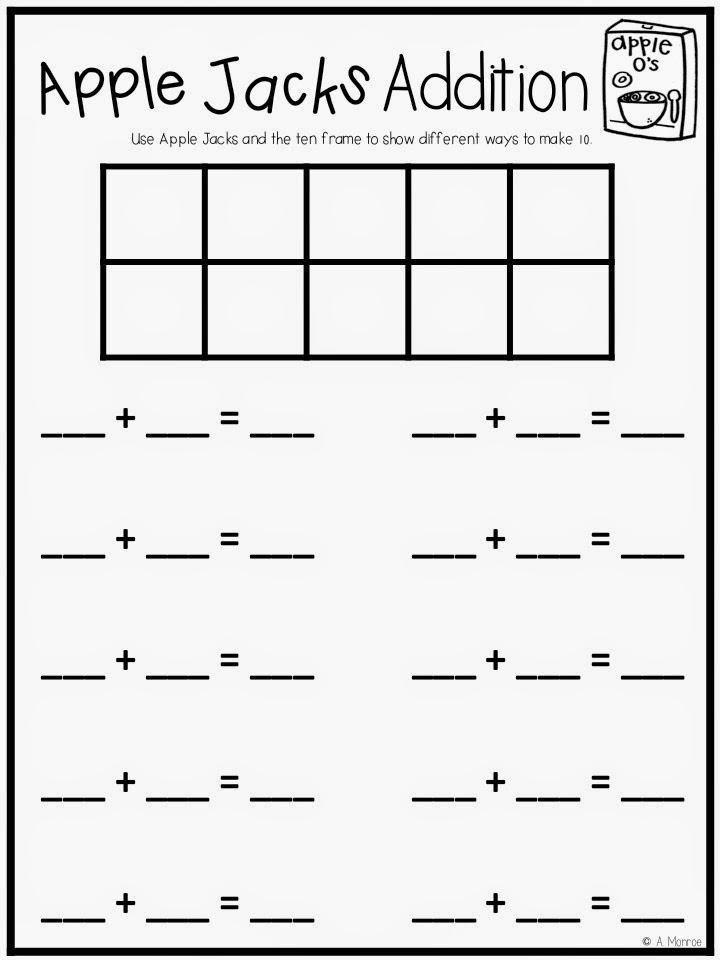
Most of our apple fun took place during our math time.  One day we practiced ten frame addition using Apple Jacks.  We had plenty of cereal left over, so a couple of days later be practiced making addition equations and solving them with a part/part/whole chart.  As you well know, kids love working with food.  They were as happy as could be when they got to eat their cereal at the end of the activity.

If you would like a FREE copy of these handouts, click on one of the picture below.

We also spent time with Cara Carroll's math and science journal, The Great Apple Investigation.  I tried to snap lots of pics of this activity.  It provided practice with different types of measurement, estimation, and focused on observations.  (As luck would have it, someone forgot to charge her camera battery.  I took two shots and then iPad to the rescue.)
To start, all the students picked an apple and I prepped our table for small groups.  After that we were off.  We observed, predicted, estimated, and measured.  All apples were throughly investigated by the end of the day.

Math with apples wouldn't be complete without a tasting and graphing activity.  This year I moved away from my normal apple tasting and tried out Sarah Cooley's Apple Tasting Party.  We sampled apples, apple muffins, Apple Jacks, apple juice, and apple sauce.  We then graphed our favorites and completed a recording sheet.  My firsties loved it.

Besides all the math skills we hit using apples, we also learned a little history by reading some books about Johnny Appleseed.  We made these cute Johnnys to brighten our hallway.  Students colored his apple their favorite apple colors.

I love teaching with apples and the students love learning with them.  There are so many directions you can go.  What we were able to fit in is just the tip of the iceberg (or maybe it is just the stem of the apple).  But now it's time for all things pumpkin, so stay tuned.

Saturday, September 20, 2014

23 Kids and Counting

This year has had an interesting start.  As usual, I've been trying out some new strategies and organizational techniques in my classroom.  The beginning of the year is always very demanding, but I really love that it is a fresh start and a chance make positive changes.
My resolution for this year is to incorporate more opportunities for student choice during our day to day routine.  My plan involves allowing more choice into our literacy centers, our math centers (now Math with Someone), and our Daily 5.  Before the school year started, I thought long and hard about how I planned to structure and organize this choice with my 18 new first graders.
Then the first bell rang and we were off.  By the end of the first week, my 18 had grown to 20.  At the conclusion of week two, we were up to 21.  Fast forward to week six and add a set twins to the mix, my class is up to 23.  I've never had 23 first graders in one class before (and I've been teaching for a while).
All sorts of new (I don't want to call them challenges, let's just say) conditions occur as a result of having 5 more students than usual in a classroom.  Things certainly take longer.  You name it . . . getting backpacks, handing out papers, going to the restroom, grading papers, making copies.  Multiply all the little daily happenings by 5 more students and time ticks away even more quickly.

Despite having these new conditions, my goal of increased choice remains the same.  One way I've added more choice is during our Daily 5 time.  In the past, I leveled groups and created a rotation schedule for each of the Daily 5 activities (Read to Self, Read to Someone, Work on Writing, Listen to Reading, and Word Work).  Since I needed to meet with small leveled groups and everyone was doing all five activities everyday anyway, I figured a schedule was fine.  However, after reading the new edition of The Daily 5 this summer, I discovered the authors have a new attitude about the number of rotations students should complete each day.
They now suggest two to three rotations each day.  This reduction in rotations helped open my eyes to a way for my students to choose their activities and to be able to mix with different groupings of students during their rotations.
I started out by creating a weekly student tracking sheet for the Daily 5 rotations.  (You'll notice Work on Writing is not on my tracking sheet.  That is because I choose for everyone in our class to write at the same time, everyday.)

When students check in with me before each rotation, they color the picture for the activity they are about to complete.  I also keep a clipboard where I mark the students' choices and I track the times students meet with me.  I call the names of the students that will read with the teacher before any of the activity selection takes place.
Students keep their tracking sheets in a journal in their desks.  We have used this system for the past few weeks and so far it has worked out great.

If you are interested in reading more about how I organized student choice during math center time, click here.

One unexpected condition I came across this week, resulting from my rather large class, was my write the room activities are going to look a bit different this year.  Meaning, I'm going to have to find new places to hang cards so that I have enough for everyone to write the room at the same time.
We did an addition write the room and a short vowel sort write the room on Wednesday and Thursday.  I guess in the past I've not introduced write the room quite so early in the year, because Wednesday's attempt was a bit of a train wreck.  However, we practiced going around to all the cards and staying in order a little more.  By the time we wrote the room on Thursday, everyone (pretty much) knew what they were doing.

Our short vowel write the room was differentiated with word/picture cards for students that need that extra support and word cards for the students that do not.  I printed the cards on red and yellow paper.  I  put a red or yellow dot at the top of the each student's recording sheet so that he/she would remember which color of card to read.
The students loved it.  They are all about getting up and moving.
If you would like a FREE copy of this write the room activity, click on the picture below.  It is available at my Teachers Pay Teachers store.

Thanks for stopping by.  I'll be back soon with some more fun from my crowded room ;) .
Have a great week.

Sunday, September 7, 2014

Math Daily 3, How We Started

When the second edition of The Daily 5 came out earlier this year I was thrilled to see the authors included a chapter about math.  The ideas in the first edition of The Daily 5 really changed my classroom for the better by helping me create independence with my young learners, which allowed me to more easily work with small groups and individuals.
A few years ago I tried to implement the Math Daily 5 that was outlined on the authors' website (thedailycafe.com).  At that point there were five components to their math block.  I found that I did not have enough time to get to all five activities each day.  So, that year I toned it down a little and did my version, which by coincidence was three parts (math by myself, math with a partner, and math with the teacher).  We stuck with that structure for the rest of the year, but I didn't love it enough to continue on that same path the next year.
Fast forward three or four years and finally, Chapter 8 of the second edition of The Daily 5 is published.  Hello Math Daily 3!  
Math Daily 3 includes:  Math by Myself, Math with Someone, and Math Writing.  

Of the three elements, Math Writing was the one I was most concerned about implementing with my first graders.  After a lot of thought and some research, (checking out what other bloggers are doing with their Math Writing) I decided to use a couple of resources that are ready to print and go.  No point in reinventing the wheel, right?
I took advantage of Jennifer Whites' Math Question of the Day Pack and Reagan Tunstall's Math Journals, to get my students started with the Math Writing portion of Math Daily 3.  Both of these packets have printable pages that students can glue into their math journals and then write their responses.
We spent a good couple of weeks doing Math Writing together as a class.  I wanted my students to understand the quality of responses I expect to see. 


My main concern with Math Writing was (and is) that students will complete it much sooner than the other activities going on during the Math Daily 3 rotations.  So I'm working on some early finisher tasks.  I plan to use math centers (that do not require recording sheets), simple games, and puzzles.  Of course, students may not need additional activities during their Math Writing time, but it doesn't hurt to have them ready just in case.


Math By Myself, in my class is a time for students to work on their math assignments independently and a time to meet with the teacher.  I meet with a leveled group of students and we do some work on the day's skill.  We use might use white boards, counters, activities mats, and so on.  After we complete our hands on activity, I'll give instructions and answer questions about that day's written assignment.  Students will return to their desks to complete their assignment, I will be available to them if they need my help.
For example, this week we worked on Touch Math addition.  During their time with me students used white boards to practice drawing the dots and circles on the touch numbers.  They also practiced writing touch math addition equations and solving them.  After our meeting students completed their assignments independently.


While Math by Myself may not be totally "by myself," it does give students some time to work on their own and it gives me some time to level instruction for the diverse needs in my classroom.


For Math with Someone I am mainly using math centers.  Most of these centers are review and some of them lay the groundwork for upcoming concepts.  
Each day students choose a partner and then a center they would like to complete.  In the past I assigned partners and setup a schedule for our math and literacy centers.  However, after reading about a simple idea to keep track of math center completions, I knew I had to try giving students a little more autonomy.


Here's how it works . . . I printed a list of student names for each center and then laminated them.  When students complete the center, they mark their names off the list.  Love it!  It's less on me and the students actually get to have some choice.   (Thanks for such a great idea Cara Carroll.)
The centers we use during Math with Someone include center pieces and recording sheets.  Each student is responsible for completing a recording sheet.  If students finish their center before the rotation time is up, they mix their cards up and match them again.


Student usually love Math with Someone.  They get an opportunity to work away from their seats and to work with a partner.  I love math centers for because they provide that constant review students need to stay on top of math skills.
For a free copy of the math center in the picture, click on the picture below.  Ten Frame Apples on Top is a ten frame/equation matching center inspired by the book Ten Apples Up on Top.  It is from my September Smarties {10 Math Centers} packet.


If you are looking for more activities like this one, click on the picture below.  I have bundled all eleven sets of monthly math centers together for a go-to Math with Someone resource


Math Writing, Math by Myself, and Math with Someone is the rotation portion of Math Daily 3.  I've not even mentioned the mini lessons.  The mini lessons are also very important to your math time.  Mini lessons are your whole group instruction time.  The lessons should be kept very brief, ten minutes at the most.
Mini lesson content is not laid out the second edition of The Daily 5.  The curriculum is up to you.  Math Daily 3 gives you a basic structure for your math time, it does not determine what you teach.
Below is my basic schedule for Math Daily 3.  The rotations are 15 minutes each and the mini lessons are ten minutes or less.  I am flexible with the last mini lesson.  I like to go over our Math Writing during this final mini lesson.  But, if we are short on time, that lesson can be omitted.


Although I am not following the book to a tee, so far Math Daily 3 has been working well in my classroom.  There are so many resources out there that have made it fairly easy to implement.  I'm sure I'll have some new insights and ideas about it as we progress through the year.  But, for now things are up and going, so I'm pretty happy.